The Hidden Liability of Golf Cart Ownership: What You Don’t Know Can Cost You
Golf cart owners face hidden liabilities that could cost thousands—discover what you're missing before it's too late.
Whether you’re cruising the back nine or running errands in the neighborhood, owning a golf cart carries legal and financial risks that most owners never consider until it’s too late.
By Paul Jensen | Intermountain Golf Cars
The golf cart has evolved. What was once a simple utility vehicle confined to the fairways of local country clubs has become a primary mode of transportation in master-planned communities, resorts, and neighborhoods across Utah, Nevada, Arizona, and Idaho. They are convenient, eco-friendly, and undeniably fun.
However, this transition from the golf course to the pavement has created a dangerous legal gray area. Many owners still treat their golf carts like oversized toys, failing to recognize that in the eyes of the law, these are motor vehicles capable of causing severe injury, property damage, and catastrophic financial liability.
At Intermountain Golf Cars, we’ve spent decades outfitting families and fleets with top-tier vehicles. We want our customers to enjoy their carts safely and securely. What follows is a comprehensive look at the legal risks of golf cart ownership, the critical differences between course-use carts and street-legal Low-Speed Vehicles (LSVs), and how to protect yourself from liability.
The Illusion of Harmlessness: Golf Cart Accident Statistics
It is easy to underestimate a vehicle that tops out at 15 to 25 miles per hour. Yet, the statistics tell a different story. According to nationwide injury data, an estimated 15,000 people are injured in golf cart-related accidents in the United States each year [1].
Because standard golf carts lack the safety features of traditional automobiles—such as enclosed cabins, airbags, and anti-lock brakes—passengers are highly vulnerable during sudden stops, sharp turns, or collisions. Ejection from the vehicle is the leading cause of severe injury in golf cart accidents, frequently resulting in traumatic brain injuries, fractures, and orthopedic trauma [2].
When these accidents occur, the question immediately shifts from medical care to legal liability. And for the owner of the cart, the answers can be financially devastating.
The Dangerous Instrumentality Doctrine
One of the most critical legal concepts golf cart owners must understand is vicarious liability. In many states, including Florida and extending into common law precedents elsewhere, motor vehicles are governed by the "Dangerous Instrumentality Doctrine" [3].
Under this legal framework, a golf cart is considered an inherently dangerous tool when operated improperly. If you lend your golf cart to a neighbor, a friend, or a visiting family member, and they cause an accident, you, as the owner, can be held entirely liable for the damages [3].
This risk is exponentially higher when minors are involved. A frequent scenario involves grandparents allowing underage grandchildren to drive the cart around the neighborhood. If that minor loses control and strikes a pedestrian or a parked car, the legal theory of "negligent entrustment" allows the injured party to sue the cart owner directly [4]. Without the proper insurance, your personal assets, retirement savings, and home could be on the line.
Course-Use Carts vs. Street-Legal LSVs: A Legal Distinction

The legal obligations of owning a golf cart change dramatically depending on how the vehicle is classified and where it is driven. It is vital to understand the distinction between a standard golf cart and a street-legal Low-Speed Vehicle (LSV).
| Feature | Standard Golf Cart | Low-Speed Vehicle (LSV) |
| Top Speed | Typically governed at 15–19 mph | Governed at 20–25 mph |
| Required Safety Equipment | Minimal (often just brakes and basic reflectors) | Headlights, taillights, turn signals, mirrors, seatbelts, windshield, parking brake, and a horn [5] |
| Where It Can Be Driven | Private property, golf courses, and specific paths | Public roads with speed limits of 35 mph or less (varies by state) [5] |
| Registration & Title | Not required | Requires a 17-digit VIN, DMV registration, and a license plate [6] |
| Driver Requirements | Varies by private property rules | Requires a valid state driver's license [6] |
The Risks on the Golf Course
If you keep your standard golf cart strictly on the course or private property, your legal exposure is generally limited to premises liability and general negligence. However, if you are drinking on the course, you are not immune to the law. Operating a golf cart under the influence of alcohol on a public course—or anywhere accessible to the public—can result in a DUI charge just as it would in a standard automobile [7].
The Risks on the Street
The moment you take a golf cart onto a public road, the legal stakes multiply. If your vehicle is not a federally compliant, registered LSV, driving it on the street is a traffic violation. If you are involved in an accident while operating an unregistered, non-street-legal cart on a public road, you may be found automatically at fault (negligence per se), severely complicating your legal defense.
Furthermore, converting a standard golf cart to a street-legal LSV is not as simple as bolting on some headlights. It requires a formal inspection, the assignment of a Vehicle Identification Number (VIN), and proper titling through your state's Department of Motor Vehicles [6].
The Insurance Gap: Are You Actually Covered?
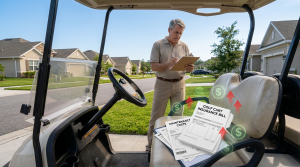
Perhaps the most dangerous assumption golf cart owners make is assuming their existing insurance policies cover their cart. In most cases, they do not.
Homeowners Insurance: Many owners believe their homeowners policy will cover golf cart accidents. However, homeowners insurance typically only provides limited liability coverage if the accident occurs on your own property [8]. The moment you drive off your driveway and onto a neighborhood street or community path, that coverage often drops to zero.
Auto Insurance: Standard auto insurance policies explicitly exclude coverage for recreational vehicles and golf carts unless they are registered LSVs added specifically to the policy.
If you hit a pedestrian or collide with a car while driving an uninsured golf cart, you will be paying out of pocket for medical bills, property damage, and legal defense fees.
To protect yourself, you need a dedicated Golf Cart Insurance Policy. These policies operate similarly to motorcycle insurance, providing bodily injury liability, property damage liability, collision coverage, and uninsured motorist coverage. For high-net-worth individuals, ensuring that your golf cart policy links to a personal umbrella liability policy is essential [4].
Best Practices for Protecting Yourself
Owning a golf cart should be a convenience, not a liability. To protect your family and your assets, we recommend the following best practices:
- Verify Your Insurance: Do not assume you are covered. Speak with your insurance agent to secure a dedicated golf cart policy with adequate liability limits.
- Understand Local Laws: Regulations vary wildly by state and municipality. In Utah, for example, golf carts are generally prohibited on public roads unless a specific city ordinance allows them [9]. Know where you can legally drive.
- Never Allow Underage Drivers: Treat the keys to your golf cart with the same strictness as the keys to your car. Do not allow unlicensed minors to operate the vehicle.
- Upgrade to an LSV for Street Use: If you intend to use your cart for neighborhood commuting, invest in a proper, factory-built LSV like the GEM e4, or have your dealer perform a fully compliant street-legal conversion.
- Drive Sober: The rules of the road apply to the cart path. Never operate a golf cart under the influence.
A Final Thought
At Intermountain Golf Cars, we believe an educated owner is a safe owner. The transition to neighborhood electric vehicles is an exciting shift in how we get around, but it requires a mature approach to safety and liability.
Before you take your next ride to the community pool or the local grocery store, take ten minutes to review your insurance policy and your local ordinances. It is the cheapest and most effective maintenance you will ever perform on your vehicle.
For more information on street-legal LSV upgrades, premium lithium battery conversions, and golf cart maintenance, visit Intermountain Golf Cars.
Sources
[1] Southbroom Golf Club: 10 Golf Cart Accident Statistics That Are Hard to Believe
[2] National Institutes of Health: Golf cart injuries have similar severity to all-terrain vehicle injuries
[3] Learn Your Rights: Golf Cart Safety & Liability: What Every Owner Needs to Know
[4] ACTEC Foundation: Owner's Liability Following a Minor's Golf Cart Accident
[5] Gregory Poole Lift Systems: What Is the Difference Between an LSV and a Golf Cart?
[6] Solana EV: How to Make Golf Cart Street Legal: Easy Steps to Follow
[7] DrivingLaws.org: Can You Get a DUI on a Golf Cart?
[8] Edison Insurance: How to Ensure Your Golf Cart Is Covered by Your Homeowners Policy
[9] Utah Code Section 41-6a-1510


Comments
Post a Comment